By Jacky Deng
Each year, the Mokakiiks Centre for SoTL hosts the SoTL Symposium, a signature gathering of the scholarship of teaching and learning community in beautiful Banff, Alberta. This annual event brings together educators, researchers, and academic leaders to share evidence-based research, exchange innovative practices, and engage in critical dialogue about teaching and learning in higher education.
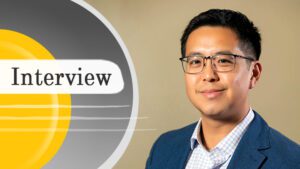
I spoke with Dr. Eugene Chan (Associate Professor, TRSM) to learn about his first experience at the conference.
Q: What drew you to attend the Banff SoTL Symposium this year?
Attending the SoTL 2025 conference in Banff was a reminder of why I value stepping outside my own discipline (marketing) to listen, reflect, and borrow ideas from others! I didn’t present at the SoTL conference in Banff, which freed me to absorb the sessions and think about how they connect to my teaching in Services Marketing and Marketing Analytics. The setting itself was inspiring—the crisp October air, the Rockies rising behind the conference centre, and the hum of conversations about pedagogy that cut across disciplines. It was a space where discomfort, agency, and simulation emerged as recurring themes, and those themes resonated deeply with me.
Q: Were there any particular sessions or conversations that stood out to you? Why?
One of the most memorable sessions was the pre-symposium workshop, “Being Comfortable with Discomfort: Centering Student Agency Requires Educators to Relinquish Control.” The facilitators asked us to confront something many of us know but rarely admit: classrooms often position instructors as the sole authorities. In marketing, this is especially true. Students expect me to deliver frameworks, models, and case studies neatly packaged for them. Yet the workshop argued that real learning requires messiness. By redistributing power to students, educators can create environments where learners co-design assessments, rubrics, and even policies. That idea unsettles many of us, because it means letting go of control, embracing ambiguity, and accepting that failure might be part of the process. But the facilitators reframed discomfort as not a barrier but a necessity for transformation.
Q: What new ideas or practices did you discover at Banff that you’d like to bring back to your own teaching or research?
I found myself reflecting on my Services Marketing course, where I ask students to design service blueprints for real organizations. The ambiguity of the task unsettles them. Some want a checklist, others fear making mistakes. I often step in to provide structure, thinking I’m helping. But the workshop made me realize that my impulse to control may actually limit their growth. If I invited students to co-create the metrics by which their projects are evaluated, they might not only feel more ownership but also experience the very co-production that defines services. Services are created jointly by providers and customers; why shouldn’t learning be co-created by professors and students? The workshop reminded me that trust is reciprocal. When we trust students with agency, they often rise to the occasion, and in doing so, they trust us more deeply as facilitators of their growth.
Another session that struck me was “From Anxiety to Insight: Senior Nursing Students’ Experience with Simulation,” presented by Melanie Hamilton and Tracy Gabriel. Their study explored how nursing students experience anxiety during mandatory simulation exercises—high-stakes activities where competency must be demonstrated. They asked whether virtual reality mindfulness exercises could help students manage this anxiety before entering simulation labs. The idea was framed within the principles of SoTL, particularly students as partners and dissemination. What resonated with me was the recognition that anxiety is not simply a hurdle to overcome but a signal of the importance of the task. In nursing, the stakes are obvious: lives depend on competence. But even in marketing, business case simulations can feel high-stakes to students. When my students role-play service encounters or pricing decisions, they often feel nervous about performing in front of peers. They worry about “getting it wrong,” about being judged. The nursing study reframed that anxiety as a sign that the exercise matters, and suggested ways to channel it into learning.
Q: What advice would you give to someone considering attending Banff for the first time?
I began to wonder whether my students might benefit from a brief reflective practice before simulations. Perhaps a guided visualization of a successful service encounter, or a mindfulness exercise to center them before stepping into role-play. The idea of borrowing from nursing education to enhance marketing education was exciting. It reminded me of Tremonte’s notion of “window shopping” across disciplines—seeing how others teach, and borrowing ideas that can be adapted to our own contexts. Listening to nursing educators discuss simulation anxiety gave me fresh perspective on my own classroom. It underscored that pedagogical innovation often comes from looking outside one’s discipline.
What tied these sessions together for me was the intersection of discomfort, agency, and simulation. Discomfort prepares students for messy realities. Agency builds trust and co-ownership. Simulation turns anxiety into applied learning. These themes are not just abstract—they map directly onto the challenges my students face in both Services Marketing and Marketing Analytics. In analytics, students often confront messy datasets, ambiguous patterns, and incomplete information. Relinquishing control means resisting the urge to provide “the right answer” and instead guiding them to ask better questions. The discomfort of ambiguity is precisely what prepares them to be agile analysts in a data-saturated world. In services, students must grapple with the unpredictability of customer interactions. Co-creating rubrics or assessments could mirror the co-production that defines service encounters. And simulations, whether in nursing or marketing, evoke anxiety because they matter. Harnessing that anxiety through mindfulness or reflection can transform fear into learning.
Q: How did attending Banff impact your perspective as an educator/scholar? Was there something unexpected you learned about yourself as a teacher, learner, or researcher during the conference?
The SoTL conference reminded me that teaching is itself a service encounter. Students arrive with expectations, anxieties, and hopes. Educators provide structure, expertise, and guidance. But the most meaningful learning happens when both sides co-create the experience. From relinquishing control to embracing discomfort, from managing anxiety to harnessing simulation, the lessons I carried home from Banff will shape my classrooms at TMU. Innovation in teaching often begins with humility: listening to students, learning from colleagues, and being willing to let go of control. In the end, SoTL is not just about scholarship—it is about trust, partnership, and transformation. And that, I believe, is the essence of both great teaching and great marketing.
Dr. Jacky Deng is an Educational Developer at the Centre for Excellence in Learning and Teaching, where he leads the Teaching Fellows program and Scholarship of Teaching and Learning (SoTL) programming. He also leads program evaluation for the TA/GA & Graduate Teaching Development Program, supports the Excellence in Teaching Program, and serves as the Faculty Liaison for the Faculty of Engineering and Architectural Science (FEAS). Jacky is a Vanier Scholar who has led national and international projects focused on improving and studying equity, diversity, and inclusion (EDI) in education and research. He is an Associate Editor for the Canadian Journal for the Scholarship for Teaching and Learning (CJSoTL) and a member of the Canadian Society of Chemistry’s Working for Inclusion, Diversity, and Equity (WIDE) Committee. In addition to teaching, learning, and research, Jacky loves basketball, running, and music.
Dr. Eugene Chan is Associate Professor of Marketing at the Ted Rogers School of Management, Toronto Metropolitan University. A passionate educator, he brings a global perspective to the classroom, having taught at leading institutions in Canada, the U.S., Australia, and Europe. He holds a PhD in Marketing (University of Toronto), MA in Social Psychology (University of Chicago), and AB in Psychology (University of Michigan), as well as an ARCT (Hons) in Piano Performance. Eugene’s teaching is informed by his research on how people make decisions in consumer, organizational, and societal contexts. He uses experimental and survey methods to explore topics such as political ideology and consumer behavior, effective communication strategies in marketing and health, and ways to encourage environmentally responsible choices. His work appears in top journals, including the Journal of Consumer Psychology, Journal of Travel Research, Organizational Behavior and Human Decision Processes, and Global Environmental Change.