By Erika Chung, PhD and Meera Govindasamy
In central Learning Support at TMU, our team is frequently surprised and delighted by the candid conversations we get to have with students about Generative AI. We’ve met students who are proud GenAI power-users, students who are genuinely unaware that they are using GenAI to plagiarise, and many students who have complex feelings about the ethics of using GenAI. Likely because we are not given the difficult task of grading student work and applying Policy 60, students seem comfortable sharing somewhat honestly how they are using GenAI. In this blog post, we share a discussion between professional staff and graduate student staff in our writing and study skills areas regarding the conversations with students related to GenAI.
Writing centre appointments follow a peer-to-peer pedagogy model in which senior students, most of whom are Master’s or PhD students, offer insight and guidance about how students can revise and improve their writing. The process involves open discussion between a student and a writing consultant. Anecdotally, it seems that our undergraduate and graduate student staff hear an especially unfiltered version of the student experience. Here is a collection of the themes that have emerged related to student experiences with GenAI at university.
Theme 1: What happens when GenAI is permitted in the classroom
“It’s the first “tool” they would like to turn to. It gets difficult when they state that they have been told by their professors to use it as an idea generator (which eventually becomes writing)”.
– TMU Learning Support Writing Consultant
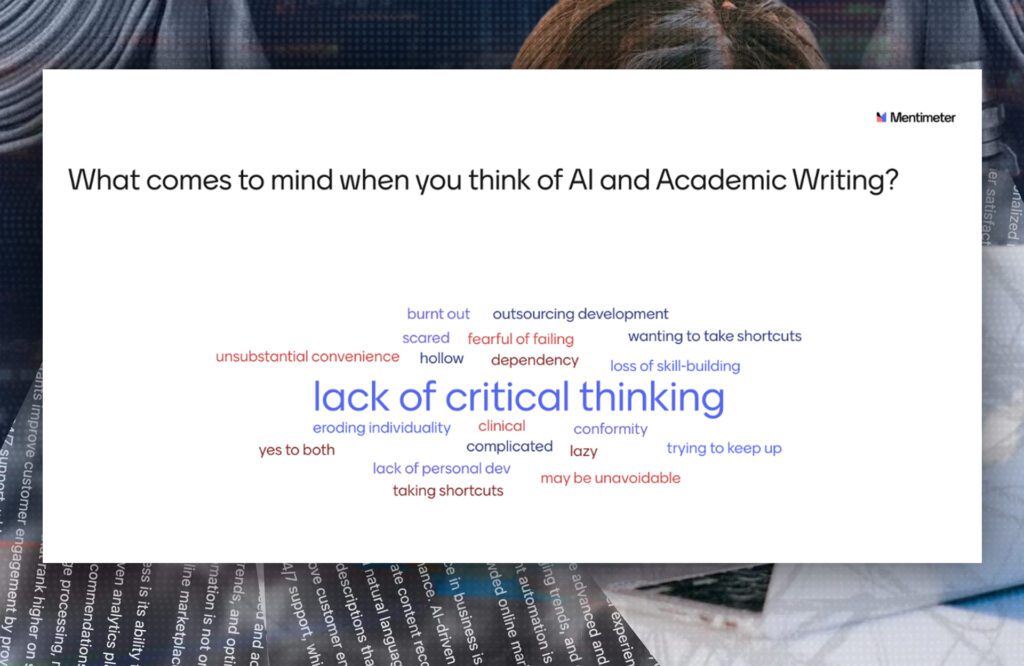
We asked our team for their insights and observations about how students are navigating learning environments that allow them to use GenAI as part of a Mentimeter activity. As one writing consultant noted, “Students whose professors give them the go ahead to use AI are often more open to sharing their usage”. Allowing GenAI in the classroom can enable students to be transparent, perhaps through citational practice, or by acknowledging how GenAI has informed their work processes.
However, other writing consultants have observed that even with allowance to use GenAI, there remain ongoing challenges in students’ research and writing skills. Another writing consultant stated, “I’ve had students share they used it [GenAI] because their assignment largely involved the use — it made it hard to discuss how to improve their assignment if they [did not] know why the AI model did what it did”. Similarly, another member of our team noted, “Some students reveal the extent to which they’re allowed to in their own programs. Others do not, and usually struggle to explain inconsistencies or the logic of their main arguments”. In other words, even though some courses and programs allow students to use GenAI, students may struggle to discern the quality and/or conclusions GenAI provides, which can further confuse or complicate the development of their ideas and writing.
In cases where students may not be as open about their use of GenAI, graduate student staff observations still provide nuance and insight into how students are navigating an increasingly complicated learning environment. A different writing consultant shared, “I’ve had way more productive convos when I give students the benefit of the doubt — it’s hard being an undergrad student and they want to try! They just might want/need our support”. Even with GenAI in classrooms, students are still forming academic skills and remain interested in guidance and support about how best to navigate and negotiate their usage and relationship with the technology. Students’ interest in seeking guidance suggests that they are aware of the impacts GenAI has on their learning and professional development.
Theme 2: GenAI’s Impact on Critical Thinking Skills
“Students seem to struggle with their critical thinking skills and explaining the relevance of their statements”.
– TMU Learning Support Writing Consultant
Writing Consultants have noted students’ continued struggle to engage with critical thinking skills, such as breaking ideas down and/or explaining how their ideas are connected to course content. Most notably, when using GenAI as part of their research and/or academic writing process, students appear to be less likely to engage deeply in critical thinking. Offloading the deep reflective cognitive process of understanding and connecting ideas to an external tool, like GenAI, results in bypassing the evaluation of information’s credibility and validity (Gerlich, 2025). This, in turn, impacts their writing skills. One writing consultant shared, “Students have difficulty following up their statements/ideas presented in their work. Rather than further developing their ideas and providing evidence, they’re reiterating the same general info”. This was similarly echoed by another member of the team who expressed that, “Students have a hard time understanding what constitutes strong writing and argumentation when they deal with AI generated text.” In other words, unless students are provided with specific instructions or prompts about how to use GenAI in their writing and work, the technology may not sufficiently facilitate critical thinking.
Theme 3: Heightened Insecurity and Anxiety
Lack of confidence
“Students who use AI are less comfortable and able to engage in discussions about their own work. They are more passive and less willing and able to critically engage, respond to my questions and edit their work.”
– TMU Learning Support Writing Consultant
While insecurity about writing is not a new phenomenon, the experience may be exacerbated for students who use GenAI to engage in cognitive offloading as a means of avoiding the discomfort associated with developing writing skills. Consequently, some students feel that GenAI can do a better job researching, generating ideas, and writing than they can. Among other topics, students’ confidence and/or lack of confidence in their own academic skills will be examined as part of a TMU Learning & Teaching Conference presentation about a recently completed research project looking at student perspectives about GenAI.
The appearance of cheating
“Some students feel terrified that they’ll be accused of using AI”
– TMU Learning Support Writing Consultant
Uncertainty about how students can use GenAI in university has sowed fear amongst students that they will be accused of academic misconduct, even when they do not think they have used GenAI inappropriately. Most students have personal experiences or have heard from friends whose authentic work was suspected of being GenAI. Heightened fear, surveillance, and mistrust has sometimes led students to become self-conscious that their own writing might sound like GenAI. For example, some students who feel they are strong writers now think twice about using an em dash. In some cases, students who are committed to not using GenAI, feel that their effort in school is made less meaningful by peers who are using GenAI to get higher grades with less effort. In group work, students worry they will face negative consequences for the choices of a peer. Consequently, students feel responsible for surveilling and managing the GenAI use of their group members. In addition to the regular stress of learning course content, some students are preoccupied with a lack of trust from professors, the university, their peers, and themselves.
Steps Forward
“I had a student share that they used it and wanted to talk through the why/why they perhaps should not — they genuinely approached it with curiosity”
– TMU Learning Support Writing Consultant
“I had a student work with me on an assignment saying they had challenged themselves not to use AI this time, and we had great session and they felt much more supported in the academic writing session than they do when using AI”
– TMU Learning Support Writing Consultant
Based on the observations from our writing consultants, as well as our own conversations with students, students could likely benefit from more dialogue regarding GenAI use in their classes. Students would benefit from discussing the following:
- The potential impact or influence GenAI may have on the learning experience in the classroom and over the course of the term.
- In courses or assignments where GenAI is permitted or encouraged, how to go about integrating critical analysis and reflection in the process.
- Sometimes it may feel like instructors and students are at opposing ends of the GenAI conversation, but this energy can be redirected to unpacking and critiquing the market–oriented motivations of these technological tools and the impact on learning environments. Addressing how GenAI is located or used within a classroom may be a way to form mutual understanding and consensus between professors and students.
- As one of the writing consultants remarked, giving students the benefit of the doubt often leads to more productive learning discussions. Students’ engagement with GenAI is not uniform, and their decisions are often shaped by intersecting pressures and considerations (commuting long distances to campus, experiencing food insecurity, navigating disabilities, balancing multiple jobs, and more). Being curious and open to hearing about students’ lives as they relate to choices about GenAI might lead to productive learning conversations and help build trust. Furthermore, by familiarizing themselves with support services on campus, faculty and staff have the opportunity to begin responding to social inequality as a factor intensifying the impact of GenAI on university learning.
Work cited: Gerlich, M. (2025). AI Tools in Society: Impacts on Cognitive Offloading and the Future of Critical Thinking. Societies, 15(1), 6–34. https://doi.org/10.3390/soc15010006

Erika Chung, PhD (she/her) is a facilitator for Writing and English Language Support and Graduate Student Support at TMU. She holds a PhD from the joint Communication and Culture program from York University and TMU. Her doctoral research focused on the intersectionality of race and gender in comic book fan culture. Her research interests include feminist media studies, popular culture, and issues regarding representation. She has a contributed chapter in the second edition of The Routledge Companion to Media Fandom, and has published in Journal of Cultural Analysis and Social Change, Canadian Journal of Communication, Panic at the Discourse and Women Write About Comics.

Meera Govindasamy is the Academic Engagement Specialist in Learning Support at TMU and a board member at the literacy non-profit, Parkdale Project Read. From 2019 to 2021 Meera was the Co-Director of the Studio for Media Activism and Critical Thought, an activist research centre at TMU. Additionally, she has been an instructor for courses about activist media and creative labour in The Creative School at TMU. Meera holds an MA in Communication and Culture from the joint program at TMU and York University, and a BA (Hons) in Sociology from Queen’s University.