
You had an idea for a Scholarship of Teaching and Learning (SoTL) project. You read a wonderful (if a bit simplistic) blog post on getting started in SoTL and turned that idea into a set of specific research questions. You’ve used those research questions to identify and plan out the systematic data collection and data analysis you’ll need to conduct for your project. You’ve developed a knowledge dissemination and mobilization plan to share your research findings with the world. You’ve even got funding!
Congratulations!
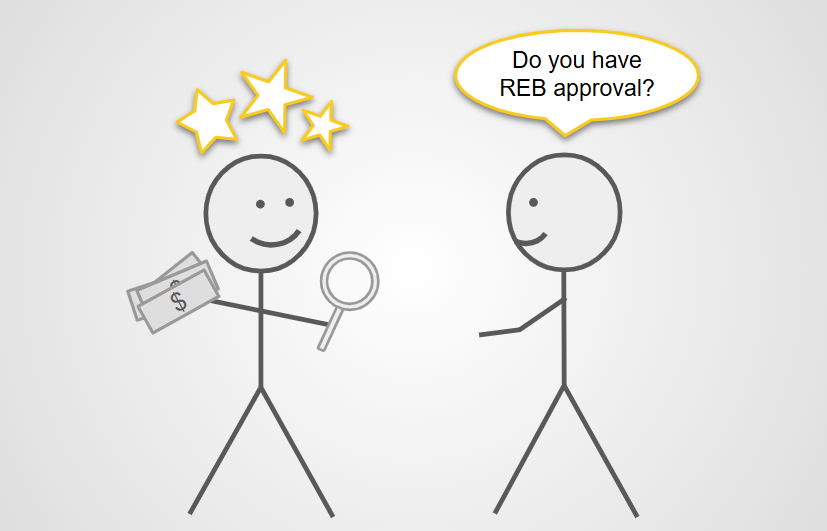
And then suddenly, just when you feel unstoppable, someone (i.e., me) asks you a question that sends a shiver down your spine: “Did you get REB approval for this?”
What’s REB? Why is it important? Do I need it? Is it too late? And how is any of this relevant to me and my SoTL project?
In this post, I’ll break down how to think through research ethics in relation to SoTL by answering seven of the most common questions.
A note on this piece and its goals:
This blog post is intended to serve as an introductory primer on research ethics for the prospective SoTL scholar, not a comprehensive document or guide on research ethics. For that, I recommend reading TCPS-2, and reaching out to the wonderful folks at TMU’s Research Ethics Board and perusing their wonderful resources, including TMU’s SoTL REB Guide.
1. Why is research ethics important in SoTL?
Before we explore what REB is, let’s take a step back and walk through some of the context for this conversation…
SoTL research involves systematic inquiry on student learning. To study student learning, we often have to study students. Students are human beings, with needs, desires, emotions, interests, passions, and rights deserving of respect and dignity.
At times in the history of human research, there have been instances in which researchers have violated people’s human dignity (e.g., here). This was bad and (you guessed it) unethical. Though the majority of historical cases are from biomedical research, you can imagine how social science research, including SoTL, can get pretty unethical, too, if left unchecked. For example:
- You want students to participate in a study testing a new software tool you’re introducing into your class, offering extra credit without providing an equivalent non-research alternative. Can students really give you voluntary informed consent if not participating will negatively impact their grades?
- You’re testing an innovative teaching method by giving high-impact resources to one random group of students (experimental group) while intentionally withholding support from other students (the control group). Is it ethical for students’ final grades and learning outcomes to be compromised purely because you need an experimental baseline?
- You’re reviewing students’ reflective journals or discussion forum posts regarding sensitive personal topics (e.g., mental health, political beliefs) and think that others in the SoTL community would benefit from seeing these excerpts. Is it ethical for you to share these without anonymizing details or securing explicit consent?
- You’ve tried an innovative teaching exercise in your class and are now inviting students to share their thoughts about the experience in one-on-one interviews with you. Every student you speak with thinks the exercise was fantastic. But how certain are you that they’re being honest? Do you think they would respond differently to someone who had no control over their grade in the course?
As time has passed and we’ve collectively learned, organizations around the world have come up with guidelines to ensure that research involving human beings is conducted ethically in the present and future. These documents include: The Nuremberg Code, the Helsinki Report, and, most importantly for our discussion today…
Canada’s Tri-Council Policy Statement: Ethical Conduct for Research Involving Humans (now on its second version; referred to as TCPS-2 for short)
2. What is TCPS-2 and what does it say?
TCPS-2 states that all research involving humans must respect human dignity, conceptualized through three core principles: (1) respect for persons, (2) concern for welfare, and (3) justice. You can think of TCPS-2 as the overarching guidebook on what makes a research project involving human subjects (un)ethical (in Canada). For some, it may not be the easiest read, but it’s where you’ll want to go to find guidance on privacy and confidentiality, conflict of interest, consent process, pilot studies, secondary use of data, and more when designing your study.
3. Who is the REB?
REB stands for the Research Ethics Board. At TMU, the REB is composed of faculty, staff, students, and community members whose primary job is to evaluate the ethical acceptability of research conducted by anyone affiliated with the institution. The REB also serves an educative role by creating resources and consulting with researchers to help them address and account for ethical issues in their research.
All institutions in Canada are responsible for having one or more REBs to review research proposals. Because the TCPS-2 was created and published by the three federal research agencies (NSERC, SSHRC, and CIHR), there are real consequences if research at an institution is found to be in violation of TCPS-2. The agency(ies) can, for example, decide to suspend funding for individual researchers, departments, or even an entire institution.
4. Do I need to get REB approval for my SoTL project?
It depends on whether your project is defined as “research” or “quality assurance”.
From TCPS-2:
“Research – An undertaking intended to extend knowledge through a disciplined inquiry and/or systematic investigation” (Glossary)
“Quality assurance and quality improvement studies, program evaluation activities, and performance reviews, or testing within normal educational requirements when used exclusively for assessment, management or improvement purposes, do not constitute research for the purposes of this Policy, and do not fall within the scope of REB review.” (Article 2.5)
This can be a tricky grey area for SoTL scholars. What makes something systematic? For example, if I collect student feedback using a survey I’ve designed, is that research or quality assurance? Do things change if I publish the findings from that investigation in an academic journal? What about presenting at a small, local conference?
The nuances and contextual considerations required for these decisions are often too varied to do justice in this piece, so I’d suggest getting in touch with the wonderful folks at the REB Office if you’re unsure where your project falls. TMU’s SoTL REB Guide is a fantastic resource on this distinction, and includes some examples of what types of projects might be considered research vs. quality assurance.
For the purposes of this post, let’s assume you are doing research.
5. How do I get REB approval?
What does “getting REB approval” look like? Well, as with most things in academia, there’s a form, typically called an ethics application or ethics protocol. At the time of writing, TMU’s ethics application form is accessible via mytorontomu.ca (click on “Online Ethics Protocol Submission” under “Research”).
The primary purpose of the ethics application form is to communicate to the REB how you have considered research ethics throughout your project and plan to conduct your research study in an ethical manner (per TCPS-2). Here are some of the questions from TMU’s Online Ethics Protocol Submission form:
- How will recruitment be conducted? Please describe all possible ways that you are planning on recruiting potential participants. If you will be emailing or phoning, please include how you will access contact information such as email addresses and phone numbers.
- Are there any already-existing relationships between the researcher and potential participants that may possibly contribute to feelings of obligation or undue influence to take part? (e.g., instructor-student, service-provider-client, manager-employee, etc.)
- Please describe what data will be collected (i.e., datasets stored electronically, signed consent forms, audio or video files, transcripts, etc.).
Though it’s not the most exciting form to fill out, as we’ve discussed, research ethics are important. Reflecting and reporting on how you will be conducting your research ethically is an essential part of the research process, ensures that your participants are treated with dignity, and helps ensure that all of us can continue doing SoTL research at TMU. And it is, ultimately, designed to help improve the quality and validity of your research.
It’s also a useful planning exercise. Beyond its primary purpose as a reporting mechanism, an ethics application form and the questions within it can serve as a way for you to reflect on and take stock of your project plan. Maybe you haven’t yet thought about how recruitment will actually be conducted, how many participants you really need, or what data you’ll actually be collecting and need to answer your research questions.
Rather than thinking of the application as something you need to get done, it can be helpful to think of it as an opportunity to work out the details and fine-tune your project.
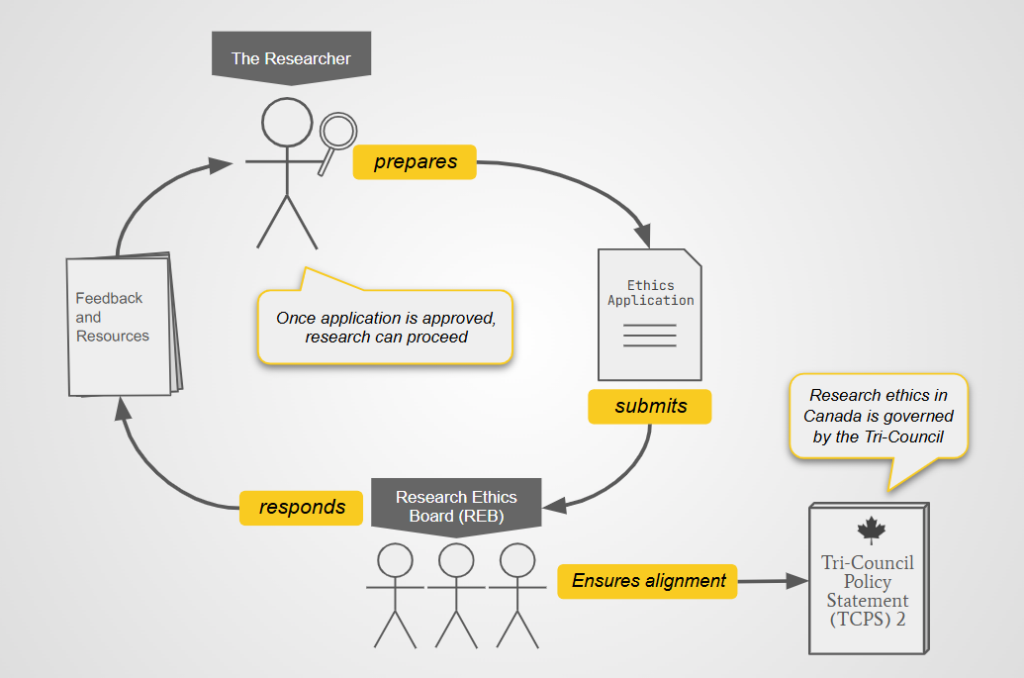
Long Description: The REB approval process starts with the researcher who prepares and submits the ethics application. The application is reviewed by the Reaseach Ethics Board who ensures the application alligns with TCPS 2, and then provides feedback and resources to the researcher. Once the application is approved, research can begin.
6. Oops, I already collected some data. Is it too late?
Hey, it happens! Sometimes you do something novel in your class that ends up being way more interesting than you expected and you want to turn that thing into a research project. For example, maybe you tried a new activity in your course, ran an evaluation, uncovered some positive/interesting data, and think it’s worth trying to publish the findings as a SoTL research paper.
Do you need REB? Like most questions regarding research ethics: it depends.
Under TCPS-2 (specifically Article 5.5), secondary use of data allows researchers to take data originally collected for a non-research purpose—e.g., course evaluations, grades, students’ responses to assignments/exams—and analyze that data for research purposes. In some ways, secondary use can feel like a superpower for SoTL scholars, because, theoretically, it provides an avenue for one to draw on any previously collected data for future research studies. It can also help avoid the interpersonal dynamics that often complicate recruitment/participation in SoTL research (e.g., perceived grading pressure). It can also help avoid disrupting active instructional time or managing a research study while trying to teach.
In practice, however, requests for secondary use of data can be rather complex. When applying for REB approval using secondary data, your pathway depends largely on how identifiable the data is.
- If the dataset was collected completely anonymously with no way to trace responses back to individual students (e.g., an anonymous course feedback), TCPS-2 Article 2.4 notes that these data may be exempt from REB review altogether (the key word here being may; always check with REB first).
- If the data contain names, student numbers, distinct writing styles, or direct quotes (i.e., things that might be identifiable) youmust submit an ethics application before starting your analysis. Depending on your situation, in your ethics application, REB may expect you to do one of the following:
- Contact former students to seek their retroactive consent. This may be incredibly resource-intensive and time-consuming because students may have graduated, they may not want to read or respond to an email with the thrilling subject line “Participate in a research study”, etc.
- Apply for a consent waiver under TCPS-2 Article 5.5A if reaching past students is practically impossible and the study poses minimal risk.
So, is it too late? Maybe. Secondary use gives you a legitimate pathway to transform past teaching artifacts into research data, but it also greatly depends on your project, the data you are trying to leverage, and the context. Proceed with caution and check with REB!
7. How do I prepare a strong ethics application for a SoTL research project
Start the application process early
As I’ve written about in a previous blog post, start thinking about research ethics as early as possible. Again, the ethics application process serves as a way for you to reflect and map out your project in great detail, and getting started early means giving yourself the time you need to (1) think deeply and carefully about your project and (2) make necessary adjustments.
The REB also gets busy (they review applications from across the entire university!), and they generally take several weeks to finish a review. You also want to make sure you have enough time to address any comments, which means you’ll want to budget at least 2-3 months from REB submission to approval.
Include core documentation
Here are some of the core documents that you’ll almost absolutely need to submit in your ethics application for a SoTL project:
- Consent forms
- Recruitment texts/scripts/posters (e.g., for class emails, D2L announcements, in-class announcements)
- Research instruments (e.g., surveys, interview protocols)
Note: TMU’s REB has templates and guidelines for many of these documents.
Make things easy for reviewers and participants
The person over at REB who is reviewing your application may not be an immediate expert in your discipline or project topic, so you’ll want to make sure that your application materials are understandable to someone outside of your field. Reviewers also love consistency; double-check that the timelines, expectations, and procedures listed in your main protocol match your recruitment scripts and consent forms word-for-word. Similarly, write recruitment emails and consent descriptions in clear, approachable language that a potential participant can read quickly and actually understand before making a choice.
Consider the dual-role of instructor and researcher
This is a big one. Because most SoTL research involves a researcher who is also an instructor for the course they are conducting research in, students might feel pressured to participate (e.g., to get a better grade). A strong application weighs the pros/cons of recruitment strategies. In many cases, it can be really helpful to have a neutral third party (e.g., a research assistant, collaborator) help with recruitment and collect consent forms while you remain completely blind to who opted in until after final grades are officially submitted.
Avoid disadvantaging control groups in your class
If you’re testing a new learning tool (or any intervention), you can’t leave half your class behind just to maintain an experimental baseline. A strong ethics application details how control groups will receive equivalent learning resources, or how non-participating students can access the tool once data collection finishes. If you offer extra credit for participating, always provide a non-research alternative for extra credit that requires equal time and effort.
Incorporate privacy strategies
A single direct quote or unique writing style can easily give away a student’s identity, especially in projects with smaller sample sizes. Strong ethics applications explain precisely how you will de-identify course assignments, aggregate responses, or assign pseudonyms before publishing your findings. (re: pseudonyms: I like to give participants the opportunity to select their own.)
Help! This is really overwhelming!
I know! It’s a lot. Between TCPS-2, the many acronyms, and the myriad of documentation you have to put together, it’s not uncommon to feel discouraged and overwhelmed. My first ethics application took a long time and a lot of back and forth with the REB before it was approved. But in the end, my project was not only more ethical, but much improved in terms of its design and rigour. As someone who’s gone through the process multiple times now, trust me when I say that it does get easier with time and experience.
And, you don’t have to navigate any of this alone. Here are some great resources available right here at TMU to help you get your project off the ground:
- Get in touch with me! I’m always happy to chat, brainstorm, or help you outline and prepare your REB submission for a SoTL project. It’s my job to help people get more engaged in SoTL at TMU, and helping you prepare a strong REB application is part of that mission.
- Contact the REB! The TMU REB hosts weekly office hours where you can drop in, ask quick questions, and get personalized feedback on your draft before submitting. They’re a fantastic group of experts who are happy to support folks who have questions about all things research ethics.
- Check out TMU’s SoTL REB Guide. Developed by the REB in collaboration with SoTL scholars at TMU, this is a fantastic resource to both read and reference as you prepare your ethics application.
- Complete an online training on TCPS-2! Some good ones: TCPS-2 Core and the Canadian Research Ethics Board Training Program.
Every SoTL scholar started right where you are today. Take it one step at a time and don’t be afraid to lean on your community and resources.
You’ve got this!
References
Stockley, D., & Balkwill, L.-L. (2013). Raising awareness of research ethics in SoTL: The role of educational developers. The Canadian Journal for the Scholarship of Teaching and Learning, 4(1), Article 7. https://doi.org/10.5206/cjsotl-rcacea.2013.1.7
Hutchings, P. (2002). An introduction to ethics of inquiry: Issues in the scholarship of teaching and learning. Menlo Park, CA: Carnegie.
Hutchings, P. (2003). Competing goods: Ethical issues in the scholarship of teaching and learning. Change, 35(5), 26-33. http://dx.doi.org/10.1080/00091380309604116

Jacky Deng, PhD (he/him) is an Educational Developer at the Centre for Excellence in Learning and Teaching, where he leads the Teaching Fellows program and Scholarship of Teaching and Learning (SoTL) programming. Prior to his time at TMU, Jacky was a Vanier Scholar who led national and international projects focused on improving and studying equity, diversity, and inclusion (EDI) in education and research. He is an Associate Editor for the Canadian Journal for the Scholarship for Teaching and Learning (CJSoTL) and serves on TMU’s Research Ethics Board.