

By Jason Matthew
Please note: generative artificial intelligence, GenAI and AI are used interchangeably in this post to refer to the same thing.

One day after class, a student approaches you to ask a question:
“Can I use ChatGPT to help with this assignment?”
You might say yes, no, or it depends.
But it depends on what?
Does it depend on the nature of the assignment? The learning outcomes? What the student wants the AI tool to do? Whether using AI would support their learning or allow them to bypass the very thinking the assignment was designed to develop?
Suddenly, that simple question becomes a little more complicated.
This is where AI-aware teaching becomes particularly useful.
What does it mean to be AI-aware?
Being AI-aware doesn’t mean you must embrace generative artificial intelligence (GenAI), and it does not mean abandoning your concerns about academic integrity, privacy, or student learning. It means being informed and intentional about how AI might affect your course, your students, and the learning you are trying to support.
I particularly like how Western University’s Centre for Teaching and Learning describes being AI-aware:
“recognizing the complexity and potential impact of GenAI and responding appropriately and in alignment with your own values.”
You might decide that AI has a valuable role in helping students practice concepts, receive formative feedback, or critically evaluate information. Alternatively, you might decide that certain learning activities must remain AI-free because the cognitive work involved is essential to developing disciplinary knowledge and skills. You might also decide on something in between. All of these can be legitimate AI-aware teaching decisions, as long as they are informed by your learning goals, disciplinary context, and your students.
The important distinction is that AI-aware teaching is not about choosing a side in the AI debate. It is about making informed pedagogical decisions.
I’m not going to lie. Becoming AI-aware takes work.
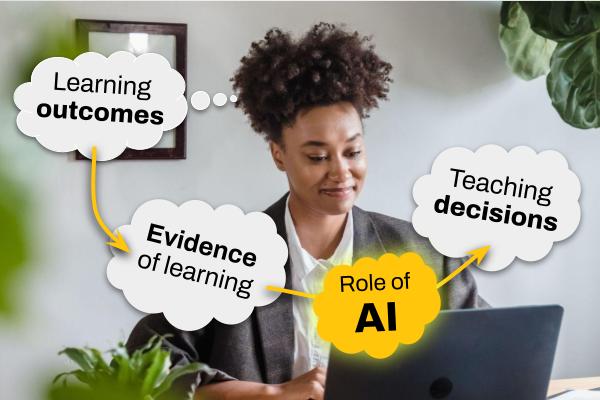
Becoming AI-Aware involves revisiting learning outcomes, reviewing assessments, reconsidering what constitutes evidence of student learning, updating course policies, and making time to have meaningful conversations with students. And all of this comes on top of existing teaching, research, service, and personal responsibilities.There is also the challenge of keeping up with technology that seems to change every other week.That is a significant demand, and my colleagues and I at the Centre for Excellence in Learning and Teaching, CELT, have been trying to find ways to help ease the burden on faculty by working collaboratively to help design assessment interventions and provide professional learning opportunities to do this work well.
So yes, becoming AI-aware takes work. But the effort can pay off. Taking a closer look at our assessments can help us think more critically about what they reveal, and what they don’t about student learning.
For example, consider a take-home assignment where students submit a polished written analysis. Before AI, we would interpret that finished document as evidence of the student’s thinking and understanding.
Now we might ask:
- What exactly am I trying to assess?
- Is it the quality of the final document, the reasoning behind it, the ability to apply disciplinary knowledge, or some combination of these?
- If AI helps produce the final document, what can I still reasonably conclude about the student’s learning?
These are assessment-design questions, not technology questions. Perhaps the assignment needs an additional checkpoint where students explain their decisions. Maybe we need to collect evidence of how their thinking developed. Or perhaps, after reviewing the assignment, we conclude that it still works well for its intended purpose. Being AI-aware does not necessarily mean redesigning everything. Sometimes it means understanding more clearly why we teach and assess the way we do. And because AI detectors have been shown to be inaccurate, good design is a more reliable path than policing.
Students want guidance, so let’s talk to them.
Our students are balancing demanding courses with jobs, family, finances, and everything else life throws at them. At the same time, they are surrounded by AI products promising to make them more productive, complete tasks faster, and make difficult work easier. But these promises rarely come with a meaningful conversation about what students might lose if they consistently outsource the thinking involved in learning.There is a difference between using AI to help understand a difficult concept and asking it to do the intellectual work that develops that understanding.That distinction isn’t always obvious, particularly to someone who is still learning the discipline.
Students are not using or thinking about AI the same way. In its 2025 Student Perceptions of AI report, Jisc (UK) found that many students have embraced AI as a learning companion, using it to understand difficult concepts, organize notes, brainstorm ideas, and receive feedback on their work. Some students avoid AI altogether because they fear any use might be considered cheating, while others worry about fairness when students who can afford premium tools may have an advantage. There are also concerns about becoming overly reliant on AI and losing important skills. Accessibility adds another important dimension. For some students with disabilities, including those with ADHD, dyslexia, and other forms of neurodivergence, AI tools can provide valuable support for understanding concepts, organizing their thoughts, and expressing their ideas. These differences remind us that decisions about AI use are also decisions about equity, accessibility, and inclusion. Across these perspectives, students expressed a common desire for clearer, practical, course-specific guidance and opportunities to help shape how AI is used in their education.
A course policy is important, but it should not be the end of the conversation. We need to explain not only what students can and cannot do with AI, but why those boundaries matter for their learning.
We might ask students:
- Where do you think AI could genuinely support your learning in this course?
- When might using AI prevent you from developing an important skill?
- What guidance would help you make responsible decisions about its use?
These conversations don’t require us (instructors) to have all the answers, only a willingness to listen, explain our reasoning, and acknowledge the uncertainties we are navigating.
Where appropriate, we might even invite students to help develop examples of acceptable and unacceptable AI use, or contribute to guidance that makes course expectations clearer. The instructor still has responsibility for the learning outcomes, academic standards, and institutional requirements. But students can offer valuable perspectives on how those expectations are understood and experienced. That builds trust and supports academic integrity through understanding rather than relying primarily on policing. Perhaps more importantly, it creates opportunities for students to develop the judgement they will need to make responsible decisions about AI long after they leave our classrooms.
Start small.
If all of this feels like a lot, I would suggest starting with one assessment rather than trying to redesign an entire course. Western University’s AI-Aware Assessment Strategies is an excellent resource for getting started. It walks instructors through a reflective process that begins with the purpose of an assessment and the values guiding its design, rather than jumping immediately to whether AI should be allowed or prohibited.
Here are four questions I would encourage you to consider:
- What am I actually assessing? What knowledge, skills, and evidence of learning do I expect students to demonstrate?
- What do I value in this assessment? Is it critical thinking, creativity, disciplinary reasoning, independent problem-solving, or something else?
- Where might AI help or hinder learning? Could it provide useful support, or might it allow students to bypass essential thinking?
- What should I do about it? Do I need to change the assignment, clarify the AI policy, make the learning process more visible, or simply communicate my expectations more clearly?
You may not end up with a redesigned assignment. You might find that the best improvement is explaining the rationale behind an existing requirement. And that’s ok.
You are not alone in this. You can always reach out to us at CELT (askcelt@torontomu.ca) and we will be happy to support you in this process.
A final thought.
You don’t need to become an AI expert, enthusiastic adopter or reinvent your teaching every time a new tool appears. But being AI-aware does require us to remain curious, stay informed, and willing to reflect on how our teaching practices support learning in a changing world. AI may change how students complete some tasks, but it doesn’t change the value of learning to think, question, and reason. If anything, those skills deserve more attention, and instructors are the people best placed to nurture them.
As you reflect on how your course is going this Fall, choose one assessment that hasn’t worked quite as you hoped, or one where you’re concerned that students may be using AI in ways that bypass the intended learning. Revisit its purpose and ask: What does AI change, and what doesn’t it? What is the learning I want to protect, and how can I help students recognize its value? Then bring those questions into a conversation with your students.
Useful Resources
AI-Aware Assessment Strategies, Western University CTL
Student Perceptions of AI 2025, Jisc
Generative Artificial Intelligence in Learning and Teaching at TMU
AI Disclosure Statement: I write the first draft of the post on my own and use AI to assist in the editing phase. I review, revise, and take responsibility for everything I publish. The ideas, arguments, professional judgement, and final decisions are my own.

Jason Matthew is an Educational Developer in GenAI and emerging technologies at Toronto Metropolitan University’s (TMU)’s Centre for Excellence in Learning and Teaching (CELT). He leads the Students as Partners in Generative Artificial Intelligence (SaP-GenAI) and the Black-Focused Pedagogy Grant (BFPG) programs at TMU and serves as Faculty Liaison for the Lincoln Alexander School of Law. Jason is also a PhD student in Curriculum and Pedagogy at the University of Toronto, where his research interests include the responsible and ethical use of GenAI in higher education. To learn more, provide feedback, ask for assistance, or continue the conversation, contact Jason at jason.matthew@torontomu.ca. (LinkedIn | YouTube Channel | Personal blog)